

Key Takeaways
- Age-related macular degeneration (AMD) blurs your central vision, while your side vision usually stays clear.
- Early AMD often has no symptoms, so an eye exam can catch changes before you notice them.
- Adults 55+, people with a family history, and people who smoke have a higher risk.
- Healthy habits, eye vitamins for some stages of dry AMD, and injections for wet AMD can help slow vision loss.
- Magnifiers, bright lighting, and low vision services can help you keep up with daily tasks.
Macular Degeneration & Eye Exams
You might notice that the words in your favourite crossword look a little smudged. Or maybe you need a brighter lamp more often than you used to. Small shifts like these are easy to brush off, but they can point to changes in your central vision. Our team at Oceanside Optometry Clinic helps you keep track of those changes, so you can act early.
Early signs of macular degeneration include blurry or wavy central vision, dark spots, and needing more light to read. Regular eye exams matter because changes in your eyes often show up during exams before you actually start to notice symptoms.
What Is Macular Degeneration?
Age-related macular degeneration (AMD) affects the macula, the central part of your retina and the part that’s responsible for central vision. Over time, as the macula becomes damaged, central vision loss may occur, though side vision is usually unaffected.
Dry & Wet Types
AMD comes in two types. The dry type accounts for about 90% of cases, while the wet type makes up about 10%. The wet type is less common, but it can progress quickly and may cause serious vision loss.
Early Signs of Macular Degeneration
Common Vision Changes
Early stages of AMD often have no noticeable symptoms. Nonetheless, you may experience:
- Blurry or distorted central vision.
- Straight lines, like door frames or tile edges, that look wavy or bent.
- Dark or blank spots appearing in the centre of your visual field.
- Difficulty reading in dim lighting.
- Difficulty recognizing faces.
Regular eye exams can often detect AMD early, while management options are more effective.
Who Has a Higher Risk of Macular Degeneration?
Some people are more likely to develop AMD than others. You have a higher risk if any of these apply to you:
- You’re 55 or older.
- You have a family member with macular degeneration.
- You smoke or are often around secondhand smoke.
- You have high blood pressure, high cholesterol, or heart disease.
How an Eye Doctor in Parksville and Nanaimo Spots Early Changes
In order to test for AMD, your eye doctor may check or do the following:
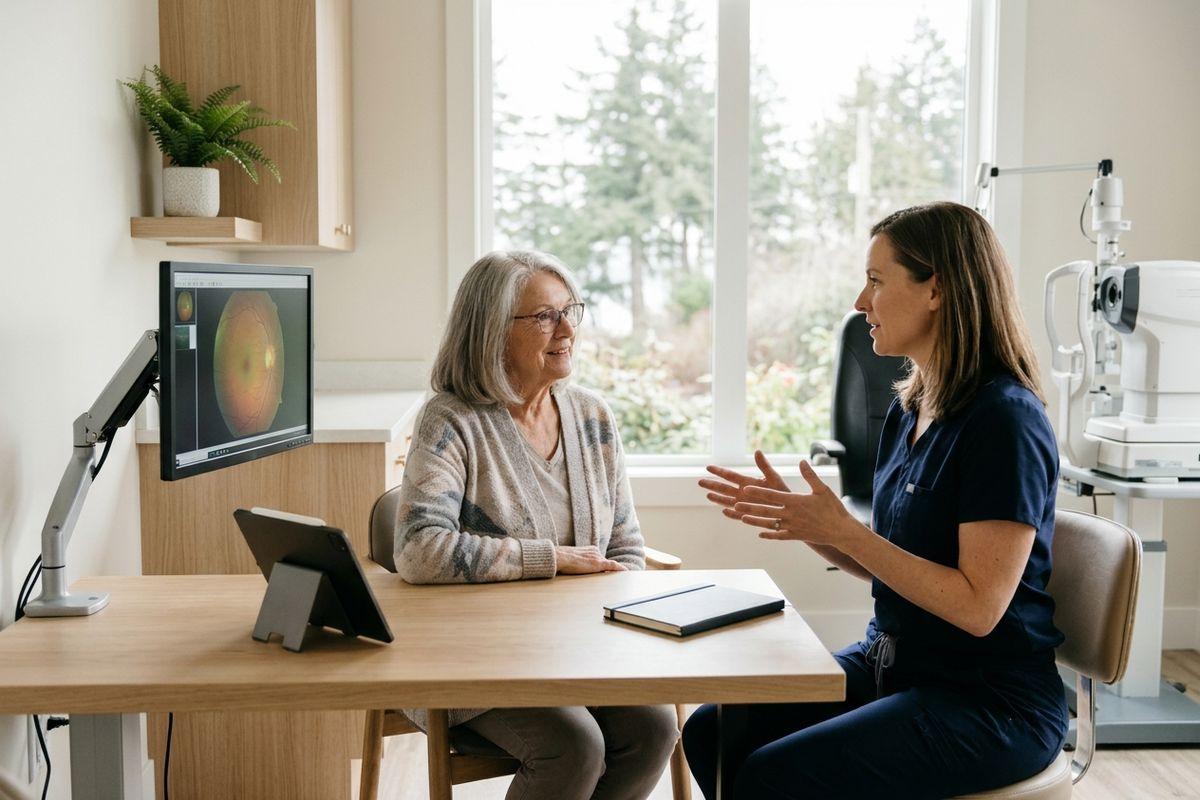
- Take detailed scans of the back of your eye.
- Using an Amsler grid test to reveal wavy or missing areas in your vision.
- Perform a dilated eye exam to get a closer look at your macula.
How Often to Book an Exam
The right exam frequency depends on your health, your family history, and potentially other factors. As your optometrist, we can recommend a schedule that fits your situation.
However, you should visit us right away if you notice either of these changes:
- Your vision turns blurry or wavy.
- New dark or missing spots appear in your central vision.
How to Slow Macular Degeneration & Protect Your Eyes
Healthy Habits for Your Eyes
Small daily choices can help support your eye health.
- Quit smoking and avoid secondhand smoke.
- Wear UV-protective sunglasses when you’re outside.
- Eat healthy foods like leafy greens, colourful fruits, fish, and whole grains.
Treatment Options for Dry & Wet AMD
Treatment can’t reverse AMD, but early care can help slow its progression. For certain stages of the dry form, specific combinations of eye vitamins may help slow changes. For the wet type of the condition, eye injections can help slow or stop vision loss.
Catching the problem early gives you more time to start care.
Support for Everyday Tasks
If AMD affects your vision, practical tools can help you keep doing what you enjoy. Options include:
- Magnifiers and high-contrast lighting make reading easier.
- Text-to-speech apps and large print books help you keep up with news and stories.
- Low vision services help you stay independent at home and around town.
Book Your Eye Exam in Parksville or Nanaimo
At Oceanside Optometry Clinic, we offer eye exams with modern technology in a calm, comfortable space where you can ask questions and get clear answers.
If you’re due for a checkup or you’ve noticed changes in your vision, book an appointment at one of our locations today.